Category: AI

  • The AI-Assisted SEO Workflow Every Small Business Should Follow (And Where It Breaks Down)

    The AI-Assisted SEO Workflow Every Small Business Should Follow (And Where It Breaks Down)

    Last quarter, a concrete contractor we work with in the Minneapolis metro picked up 1,210 more search impressions than the quarter before. Two of their strongest local queries earned no clicks at all.

    That gap is the whole problem, and it is why the AI SEO workflow below starts somewhere different than most advice you have read. Not with a tool. With your own search data, and with an honest look at which rankings are still worth anything.

    Here is the process we run, the step almost everyone skips, and the point where doing it yourself stops making sense.

    Why most AI SEO advice sends you shopping instead of working

    Search the topic and you get tool roundups. Thirteen tools, five tools, the seven best platforms for 2026. Each one tells you what to buy and none of them tell you what order to do the work in.

    The tools are mostly fine. That is not the issue. The issue is that a tool answers “what should I look at,” and the thing you actually lack is a repeatable sequence with decision points in it, so that the work happens on a Tuesday in February whether or not anyone feels inspired.

    You can own Semrush and Surfer and still have published nothing in five months.

    The 23x statistic you keep seeing does not describe your business

    You have probably seen the claim that AI search visitors convert 23 times better than organic search visitors. It comes from Ahrefs, published June 16, 2025, and it is real: AI search made up 0.5% of their traffic over 30 days and produced 12.1% of their signups.

    It is also Ahrefs measuring Ahrefs.

    They are a software company with a free-tool funnel, a large library of educational content, and an audience of marketers who sign up for products online at two in the morning. In the same post they note their visitors tend to arrive already deep into the research process. That describes their business. It does not describe a manufacturer quoting custom tooling, or a contractor who books work over the phone after a site visit.

    When an agency quotes that number at you, ask whose data it is. The honest answer is that nobody has published a reliable AI-search conversion benchmark for home services, manufacturing, or most of ecommerce. We do not have one either.

    What the click data actually shows

    Fewer clicks, and the loss is concentrated in a specific place.

    The Pew Research Center tracked the browsing of 900 US adults across 68,879 Google searches in March 2025. When an AI summary appeared, people clicked a traditional result 8% of the time, against 15% when no summary appeared. Clicks on the links inside the summaries happened on 1% of visits. People also ended their session more often after a page with a summary, 26% versus 16%.

    One correction worth making, because this number gets mangled constantly. You will see it claimed that AI features now touch 58% of all searches. Pew’s 58% is the share of people who ran at least one search that month producing an AI summary. At the query level it was 12,593 of 68,879, closer to 18%. Big number either way. Not the number people keep citing.

    Now here is what that looks like inside a real account.

    Position 7 is the new page 2

    In our concrete client’s Search Console data for the last three months, queries ranking in the middle of page one produced almost nothing:

    Query  Avg position  Impressions  Clicks  
    concrete services minneapolis  9.0  312  0  
    concrete contractors st. louis park  7.8  216  0  
    quality concrete (head term)  7.9  1,618  16  
    quality concrete services  4.3  445  36  

    Read the last two rows again. The head term sat at position 7.9, pulled 1,618 impressions, and returned 16 clicks. A narrower term sat at position 4.3, pulled less than a third of the impressions, and returned more than twice the clicks.

    The standard advice in this business is to hunt for “striking distance” keywords in positions 4 through 10 and nudge them up. That heuristic is now half wrong. Positions 4 through 6 still pay. Positions 7 through 10 increasingly do not, because an AI summary, a map pack, and a few ads sit above them and the user has their answer before they scroll.

    Account-wide across that same band, the client gained 43% more impressions and 31% more clicks quarter over quarter while their average position improved from 8.1 to 6.7. So this is not a disaster story. It is a targeting story: the work paid off precisely where it moved things into the top five, and produced nearly nothing everywhere else.

    One account, one industry, one metro. Do not treat it as a law. Check your own numbers against it.

    The six-step AI SEO workflow

    Six steps, unevenly weighted. Steps one and six take the most judgment and the least software.

    1. Start with your own Search Console data, not a keyword tool

    Open Search Console, set the range to the last three months, and sort your queries by impressions. You are looking for terms sitting between positions 4 and 6 with impressions and weak clicks. Those are reachable. Terms parked at 8 or 9 need a different decision: either commit real effort to move them inside the top five, or let them go.

    Keyword tools estimate. Search Console reports what actually happened on your site. Start with the one that is true.

    2. Read your query list for sentences, not keywords

    This is the step nobody tells you about, and it takes ten minutes.

    Scroll your query list for anything written like a sentence. In a metal machinery client’s account we found “where can i buy a new tech machinery rollformer in the united states?” pulling impressions at position 8.8. In Eclipse’s own account: “best us-time-zone b2b commerce agency under $750k for a mid-tier manufacturer.”

    Nobody types that into a search box. That is a query with a budget ceiling, a geography, and a buyer profile inside it, which is what a question looks like after it has passed through an AI assistant. When those start showing up in your Search Console, you are already being surfaced in AI-mediated search, and the phrasing tells you exactly what your buyers are trying to figure out.

    Write those down. They are your next six months of content topics, in your customers’ words, for free.

    3. Cluster with AI, then cut about a third

    Paste your query list into ChatGPT or Claude and ask it to group the terms by the underlying job the searcher is trying to do, not by keyword similarity. This part AI is genuinely good at, and it takes two minutes instead of an afternoon in a spreadsheet. It is the same principle behind anywhere else in the business: let the machine do the sorting, keep the judgment for yourself.

    Then cut roughly a third of what comes back. The model will confidently cluster queries that are irrelevant to you, seasonal, or already served by a page you forgot you had. You know your business and it does not.

    4. Write it yourself, use AI on the structure

    Unpopular position, and we will hold it: have AI outline, not draft.

    Ask it what questions a piece has to answer, what order they belong in, and what a competitor is likely missing. Then write the prose yourself, or have whoever knows the trade dictate it while someone types.

    The cost of doing it the other way is not a Google penalty. It is that AI-drafted copy contains no specifics, because the model does not know your lead times, your minimum order, or why you stopped offering a service in 2023. Specifics are the entire reason someone chooses you, and they are the thing an AI engine can quote.

    If you must draft with AI to get moving, budget real editing time. Thirty minutes of a knowledgeable person adding real numbers beats three hours of polishing generic sentences.

    5. Make every section answer its own question

    AI engines quote passages, not pages. A section that opens with “as we discussed above” cannot be lifted out and cited, because it does not stand up alone.

    So: use a question as the heading where the query is a question, answer it in the first sentence beneath, and make each section survive being read in isolation. This is not a trick for robots. It is also how a busy person skims.

    6. Fix the source data the AI engines actually read

    Your Google Business Profile, your major directory listings, your hours, your service area, your NAP consistency. Boring, and it is where wrong answers come from.

    There is no edit button inside ChatGPT. You cannot correct an answer directly. Fixing the underlying sources and waiting for re-crawl is the only lever available, which is why it is worth doing before you spend on content.

    How do you know if it’s working?

    You check it by hand, monthly, and you accept that the measurement is worse than what you are used to.

    Write down five to ten questions a real buyer would ask, phrased the way a person talks. “Best concrete contractor in St. Louis Park.” “Who can build a rollformer for a mid-size shop.” Run them through ChatGPT, Perplexity, and Google, on the same date each month. Record whether you appear, whether you are cited with a link, and who shows up instead.

    That is tedious and it works. Once a month is enough to see a trend.

    Before you buy an AI visibility platform, know what you are buying. Every vendor computes its own visibility score with its own prompt set, its own engine mix, and its own weighting, so two tools will hand you two different numbers for the same brand and neither is wrong. Treat any score as a trend line on your own fixed prompt set, never as a grade you can compare to a competitor’s.

    We use SEOcrawl and Ahrefs for this. Both are useful. Neither will tell you what your number “should” be.

    Who should not run this workflow themselves

    Plenty of businesses should run it in house, and if that is you, take the six steps above and go.

    Here is the honest constraint. This workflow needs roughly six to ten hours a week, sustained across two or three quarters, from someone who can read Search Console without guessing at it. That is our own estimate from client work, not an industry statistic. The failure mode is almost never the tools. It is month four, when the person who owned this got pulled onto a job site and the monthly check stopped happening.

    So the real question is not whether you can do this. It is whether anyone on your payroll owns it on a bad week.

    If the answer is no, buying more software will not fix it, and you are better off either hiring for the role or bringing in help. That is the work we do, and you can see how we scope it. For reference, our fixed-scope engagements start at $8,000, and most clients move to a retainer afterward because this is maintenance work, not a project you finish. If that number is out of range right now, run the workflow yourself. It genuinely works. It just needs an owner.

    Start here this week

    Pick five questions your best customer would ask out loud. Run them through ChatGPT and Google, write down what comes back, and note who got named instead of you.

    That takes twenty minutes and it will tell you more about where you stand than any audit you could buy. If you would rather hand the whole thing to someone.

    Common questions about AI SEO workflows

    How do I check whether ChatGPT cites my business?

    Ask it the questions your buyers ask, phrased naturally, and read the answer. Use prompts like “best [your service] in [your city]” or “who can [solve my specific problem] near [location].” Note whether you appear, whether the answer links to your site, and which competitors get named. Free tools exist that automate this, but the manual version costs nothing and shows you the actual wording.

    How often should I check my AI visibility?

    Monthly is enough. Pick a consistent date, run the same fixed set of prompts, and log the results in a spreadsheet. Checking more often mostly captures noise, since answers vary between runs even with identical prompts. What matters is the direction over several months, not any single result. Quarterly is acceptable if monthly will not realistically happen.

    Can I change what ChatGPT says about my business?

    Not directly. There is no dashboard where you edit your own entry. What you can change is the underlying information the models draw from: your website, your Google Business Profile, directory listings, and third-party mentions. Correct inconsistencies at the source, and answers tend to self-correct over subsequent crawls. Expect weeks, not days.

    Do AI visibility scores from different tools mean the same thing?

    No. Each vendor builds its own score using a different prompt set, a different mix of AI engines, and its own weighting formula. Two platforms will report different numbers for the same brand on the same day, and both can be internally correct. Use a score as a trend line within one tool over time. Do not compare it against a competitor’s number from a different tool.

    Does AI SEO replace traditional SEO?

    No, and treating them as separate budgets causes problems. The same fundamentals drive both: content that answers real questions, clear site structure, accurate business information, and credible third-party mentions. AI engines lean heavily on conventional search infrastructure to find and rank sources. The practical change is in how you structure content and what you measure, not a different discipline.

    How long before an AI SEO workflow shows results?

    We have not found reliable published data on AI-search-specific timelines, and treat any agency promising a number with suspicion. From our own client work, expect the first movement in Search Console impressions around month two or three, with click and citation changes following later. Two to three quarters of consistent work is a realistic planning horizon. Anyone guaranteeing faster is guessing.

  • AI Workflows for Businesses: How to Systemize Operations Without Adding More Busywork

    AI Workflows for Businesses: How to Systemize Operations Without Adding More Busywork

    Most businesses don’t have a tool problem. They have a systems problem.

    Leads come in from the website, email, social, ads, referrals, and the phone. Follow-ups live in someone’s inbox. Customer details get copied by hand from one platform to another. Reports get built manually every week. Tasks get created after someone remembers to create them.

    The business keeps moving, but too much of that movement depends on one person remembering every step.

    That’s where AI workflows help. Not because AI is magic, and not because every business needs another platform bolted on. AI workflows are useful when they turn a process you repeat every week into something reliable that doesn’t depend on memory.

    The problem isn’t a lack of AI. It’s a lack of systems.

    Most businesses already run plenty of software. A website, a CRM, email marketing, a calendar tool, project management, accounting, analytics, maybe some industry-specific platform on top of all that.

    The problem is those tools don’t talk to each other.

    A form gets submitted but never creates a CRM record. A sales call happens but no follow-up task gets assigned. A customer approves a project but someone still has to build the onboarding checklist by hand. A manager wants a weekly snapshot but the numbers live in five different places.

    That’s operational drag. People spend their time moving information around instead of using it.

    AI workflows fix that by connecting the steps that already happen inside your business, so the process repeats itself correctly without someone babysitting it.

    What an AI workflow actually is

    It’s a repeatable process that uses automation, integrations, business rules, and AI to move work from one step to the next.

    A lead fills out a form. The workflow captures it, has AI summarize what the lead needs, checks it against your criteria (service type, budget, location, urgency), creates the CRM record, assigns a task, drafts a first response, and schedules the follow-up. Your team gets an alert instead of a raw form submission sitting in an inbox.

    The human is still making the decisions. They’re just not the one manually stitching every step together anymore.

    Every workflow worth building has the same five pieces:

    • A trigger — a form submission, a signed proposal, a support request, a calendar booking
    • Business rules — what should happen, and when, based on conditions you set
    • Integrations — the tools it connects, your CRM, email, project management, spreadsheets
    • AI steps — summarizing, classifying, drafting, scoring, recommending
    • Human approval points — where judgment, trust, pricing, or a customer relationship still needs a person

    That last one matters most. Good AI workflows don’t remove judgment. They remove the busywork sitting around it.

    Where this actually pays off

    Start with the process you repeat most, not the one that sounds most impressive.

    Lead intake. Someone reads every inquiry, decides if it’s a fit, adds it to the CRM, routes it, and writes a reply. An AI workflow can summarize the inquiry, classify it, tag the service interest, check basic qualification, route it to the right person, and draft the first response for a human to approve. Faster follow-up, and it’s consistent every time instead of depending on who happened to see it first.

    Sales follow-up. This is where revenue quietly leaks out of most businesses. Interested lead, no follow-up scheduled. Proposal sent, no reminder set. Question asked, answer buried in an inbox somewhere. A workflow can build the follow-up task, draft the check-in email, and flag anything sitting too long in the pipeline. The message still goes out as a draft for a human to send, not blind.

    Customer onboarding. The first few days after someone says yes set the tone for the whole relationship, and it’s also where a lot of businesses create friction they don’t need to. Folders, intake forms, internal tasks, kickoff scheduling, missing-asset tracking, all of it can trigger automatically the moment a deal closes instead of waiting on someone to remember to start it.

    Support and reporting. Support requests can get summarized, classified, and routed on arrival, with recurring issues surfaced instead of buried. Reporting works the same way: pull from the systems you already run and turn it into one operating summary, new leads, source performance, open proposals, overdue follow-ups, instead of a dashboard nobody remembers to check.

    Where n8n, Dify, and Zapier actually fit

    The tool isn’t the strategy, the workflow is. But once you know what you’re building, the tool choice gets easy.

    Zapier is the right call for straightforward app-to-app automation where speed matters more than complexity.

    n8n is what we reach for when a workflow needs branching logic, custom API steps, or real control over how data moves. It’s our default for anything with more than two or three decision points.

    Dify earns its spot when the workflow needs an AI-powered assistant, chatbot, or agent doing more than routing, an actual structured LLM interaction.

    Most systems we build end up using more than one. A CRM owns the customer record, n8n connects the systems, AI drafts and summarizes, and a project management tool tracks the work. That’s normal. The point isn’t to pick a winner, it’s to design the workflow first and let the tools fill in around it.

    What not to automate

    Don’t automate a broken process. If the steps are unclear today, automation just makes the confusion move faster.

    Don’t let AI make high-trust decisions without a human checking it first. Pricing, contracts, sensitive customer communication, legal language, anything public-facing, that all needs a person in the loop.

    Don’t build a workflow with no owner. Someone has to be responsible for watching it, fixing it when a tool changes something, and improving it over time. Automation left unattended breaks quietly and nobody notices until a customer does.

    How we actually approach this

    We work across home services, manufacturing, and ecommerce, and the tools change client to client, n8n as the connector layer, ClickUp or HubSpot as the CRM and project layer, QuickBooks for the financial side. But the questions we start with don’t change:

    Where is the business losing time? Where are leads or customers falling through the cracks? Which repeated tasks are slowing the team down? What does leadership need to see that they’re not currently getting? Which steps genuinely need a human, and which ones are just busywork wearing a human’s name?

    From there it’s mapping the current process, defining what success actually looks like, picking the right platform for that specific workflow, and building in the approval checkpoints before anything goes live. Then testing it against real, messy inputs, not the clean example that works in a demo.

    Start with one workflow

    Don’t start by asking how many tools you can bolt on. Start with one process, the one that’s repeated, important, and currently too manual. Lead intake is usually the easiest place to start. Sales follow-up, onboarding, support triage, and reporting are close behind.

    If your business has repetitive tasks, missed follow-ups, disconnected systems, or reports nobody has time to build, that’s exactly the kind of problem Eclipse Digital solves. We’ll help you find the right workflow to start with and build a system around it that actually holds up.

  • Your business doesn’t need more tools. It needs mission control.

    Your business doesn’t need more tools. It needs mission control.

    You know the morning drill. Check email in Gmail. Review your calendar. Jump to Slack for team messages. Open HubSpot to scan the sales pipeline. Switch to Telegram for client updates. Back to email for that urgent message. What were you doing again?

    By 9:30 AM, you’ve already context-switched a dozen times. And the day has barely started.

    This isn’t a productivity problem. It’s an architecture problem. Every tool you add to your stack makes you more powerful on paper—and more fragmented in practice. You’re not managing a business. You’re managing a control panel with 47 different buttons spread across 12 different rooms.

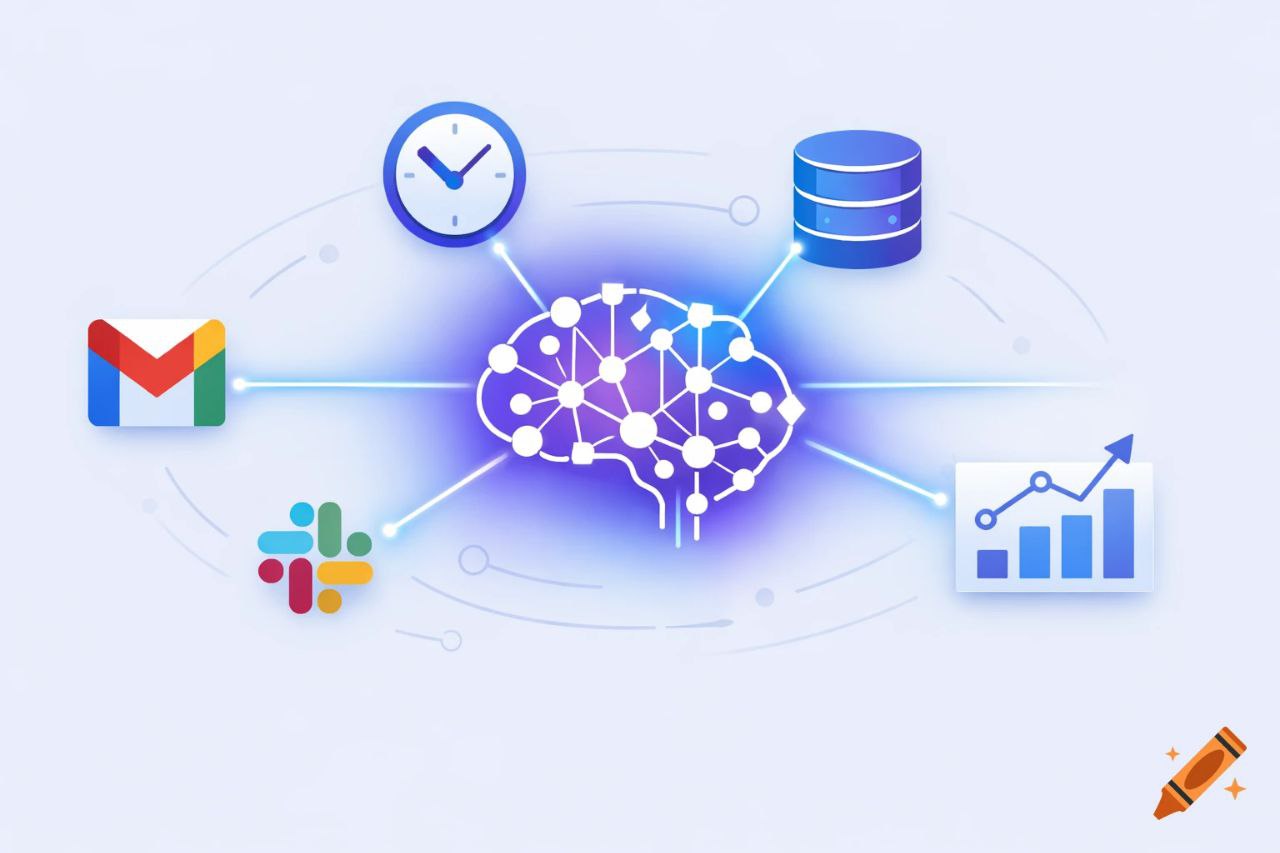
    What if there was a better way? Not another tool to add to the pile, but a single AI assistant that could reach into all of them—reading your emails, monitoring your calendar, updating your CRM, and surfacing what actually matters when it matters.

    That’s what OpenClaw does. And it’s not some distant future concept. It’s working software you can install this weekend.

    What is OpenClaw?

    OpenClaw is an open-source framework that transforms Claude AI from a chatbot into an integrated business assistant. Think of it as the connective tissue between your brain and your business systems.

    Instead of you jumping between Gmail, HubSpot, Slack, and Asana to piece together context, OpenClaw becomes your digital chief of staff. It connects to those systems on your behalf. You ask questions in plain English. It takes action.

    “What’s on my calendar today and do I need to prep anything?”

    OpenClaw checks your calendar, scans related emails, pulls relevant HubSpot contacts, and gives you a briefing. No tab-switching required.

    “Update the deal with Acme Corp to ‘Proposal Sent’ and remind me to follow up Friday.”

    Done. CRM updated. Reminder scheduled. You keep thinking.

    This isn’t automation in the traditional sense—rigid workflows that break when reality doesn’t match the script. It’s intelligence. OpenClaw understands context, maintains memory across conversations, and adapts to how you actually work.

    Why your business needs AI mission control

    Let’s be honest about what “productivity tools” have given us: productivity theater.

    We have amazing software. CRMs that track every customer interaction. Project management tools with Gantt charts and kanban boards. Communication platforms with threads and channels and reactions. Email clients with labels and filters and snoozing.

    And yet—deals slip through the cracks because someone forgot to follow up. Client questions sit unanswered in Slack while you’re drowning in email. That important contract is somewhere in Google Drive, but where exactly?

    The problem isn’t the tools. It’s that each one lives in its own silo, and you’re the only bridge between them.

    OpenClaw solves this through four capabilities:

    Centralized access: One interface to all your systems. Ask about anything, from anywhere.

    Active monitoring: Instead of you checking each tool manually, OpenClaw watches for what matters—deals stuck in pipeline, unanswered messages, upcoming deadlines—and surfaces them.

    Intelligent automation: Not just “if this, then that” rules, but actual reasoning. “This email is asking for pricing, pull the standard rate sheet, but check if we’ve quoted them before and reference that number.”

    Always-on availability: Your business doesn’t pause at 5 PM. OpenClaw doesn’t either. Set it to monitor overnight and wake you only for true emergencies.

    The result? You spend less time managing tools and more time running your business.

    How it actually works

    OpenClaw sits between Claude AI and your business infrastructure. Here’s the basic architecture:

    The Gateway runs on your computer (or a server) and handles the connections. Think of it as the central hub.

    Skills are pre-built integrations with specific services. There’s a HubSpot skill, a Google Workspace skill, a Telegram skill, and more. Each one teaches Claude how to interact with that service’s API.

    Memory gives your assistant context that persists across conversations. It’s not starting from zero every time you ask a question. It remembers your clients, your preferences, your ongoing projects.

    Heartbeats are scheduled check-ins where OpenClaw monitors your systems and reports back. “Your 2 PM meeting starts in an hour. The client emailed an updated agenda. Pipeline has three deals idle for over a week.”

    Multi-channel means you can interact through Telegram, Discord, web interface, or command line. Use whatever fits your workflow.

    The magic is in the combination. Claude’s language understanding plus direct system access plus persistent memory equals an assistant that gets smarter the more you use it.

    Real-world example: How Eclipse Digital uses OpenClaw

    At Eclipse Digital, we built an OpenClaw assistant named Digi. Here’s what a typical day looks like:

    Morning (7:30 AM): Digi sends a Telegram message with the daily briefing. Calendar summary with prep notes for each meeting. Overnight emails flagged by priority. HubSpot pipeline snapshot highlighting deals that need attention.

    This happens automatically via a scheduled heartbeat. No app-opening required. Just coffee and a clear picture of the day ahead.

    Throughout the day: Client emails come into Digi via Telegram. “What’s the history with Apex Manufacturing?” Digi pulls the HubSpot record, recent email threads, and past project notes. Full context in 30 seconds.

    When a discovery call wraps up, a quick Telegram message: “Create deal for ‘Apex – Website Redesign’, $15k, closing April.” Digi updates HubSpot immediately. No CRM tab open. No “I’ll update it later” (and forget).

    Meeting notes? Dictate key points to Digi. It logs them to the appropriate client record and extracts any action items.

    Weekly (Friday 4 PM): Digi sends a pipeline health report. Deals in each stage, week-over-week movement, stalled opportunities with recommendations. Plus a scan for dormant clients worth re-engaging.

    The result? Deals don’t fall through cracks. Client questions get answered faster. Pipeline visibility is instant instead of “let me pull that report.” And all of this happens through Telegram—from phone, desktop, anywhere.

    The time savings are measurable. Roughly 60-90 minutes per day that used to go toward “check email, check calendar, check CRM, update CRM, check Slack.” That’s 5-7.5 hours per week redirected to actual client work.

    Getting started: Your first weekend with OpenClaw

    Ready to build your own mission control? Here’s the step-by-step.

    Step 1: Install OpenClaw (30 minutes)

    OpenClaw runs on Linux, Mac, or Windows (via WSL). You’ll need Node.js installed (it’s free).

    Open your terminal and run:

    npm install -g openclaw
    
    openclaw gateway start

    That’s it. The gateway is now running and ready to connect.

    Step 2: Add your API keys (20 minutes)

    OpenClaw needs permission to access your services. You’ll configure this in `~/.openclaw/config.yaml`.

    At minimum, you need an Anthropic API key (for Claude). Get one at console.anthropic.com—it takes about 5 minutes and costs $0 to set up.

    Add service keys as you go: HubSpot, Google Workspace, Slack, whatever you use. Each service has documentation for generating API credentials.

    Step 3: Connect a communication channel (10 minutes)

    The easiest option is Telegram. Create a bot (search for @BotFather in Telegram), get your bot token, add it to OpenClaw’s config.

    Now you have a direct line to your AI assistant from your phone. No web interfaces, no separate apps.

    (You can also use Discord, a web interface, or pure command line—whatever fits your style.)

    Step 4: Install your first skills (20 minutes)

    This is where OpenClaw gets superpowers. Install skills for the services you use:

    clawhub install hubspot
    
    clawhub install gog

    The `gog` skill handles Google Workspace—Gmail, Calendar, Drive, Contacts, Sheets.

    Each skill comes with documentation. You’ll add API credentials for that specific service, and suddenly your assistant can read your emails, check your calendar, update your CRM.

    Step 5: Define your assistant’s personality (30 minutes)

    This is the fun part. OpenClaw uses text files to configure how your assistant thinks and acts:

    SOUL.md defines personality and communication style. Want terse, bullet-point answers? Chatty and encouraging? Professional and direct? You decide.

    MEMORY.md is your assistant’s long-term knowledge base. Client background, your preferences, company policies—anything it should remember permanently.

    HEARTBEAT.md sets up automated tasks. “Check my calendar every morning at 7:30 and send a briefing. Scan my email inbox every 2 hours. Alert me if any HubSpot deals are idle for 5+ days.”

    You’re not coding. You’re writing instructions in plain English.

    Step 6: Start small and build (Ongoing)

    Don’t try to automate everything on day one. Start with simple requests:

    “What’s on my calendar tomorrow?”

    “Show me open deals in HubSpot.”

    “Summarize my unread emails from the last 4 hours.”

    Your assistant learns your patterns, builds memory, and becomes more useful over time. Within a week, you’ll wonder how you managed without it.

    Beyond the basics: Advanced capabilities

    Once you’re comfortable, OpenClaw has deeper capabilities:

    Sub-agents let you delegate specialized work. Need a blog article written? Spawn a content creation sub-agent. Code review? Spawn a coding agent. Each has its own context and memory.

    Custom dashboards can be generated on demand. “Build me a web dashboard showing this week’s sales activity and revenue.” OpenClaw writes the HTML, serves it locally, and gives you the link.

    Workflow automation chains multiple steps. “When a new deal enters ‘Proposal Sent’ stage, pull the proposal from Drive, email it to the client, and schedule a follow-up for 3 business days.”

    Knowledge management handles the difference between ephemeral and permanent. Daily logs capture what happened. Curated memory files distill lessons learned. Your assistant gets genuinely smarter over time.

    Security: What about my data?

    Valid question. You’re giving an AI access to sensitive business systems. Here’s how OpenClaw handles security:

    API key management: Keys are stored locally, encrypted, never transmitted to third parties. OpenClaw is open-source—you can audit exactly what it does.

    Permission scoping: Give each integration the minimum access it needs. HubSpot can read deals but not delete them. Gmail can read inbox but not send as you (unless you explicitly allow it).

    Audit logging: Every action is logged. You can review exactly what your assistant did and when.

    Data isolation: Separate workspaces for separate contexts. Your personal assistant doesn’t mix with your work assistant.

    Human oversight: Sensitive actions (like sending emails or deleting records) can require explicit approval. OpenClaw asks, you authorize, then it proceeds.

    Is it risk-free? No. But compare the risk profile to “every employee has direct access to these same systems” or “we use a third-party SaaS tool that processes our data on their servers.” OpenClaw runs on infrastructure you control.

    What does this actually cost?

    Let’s talk numbers.

    Anthropic API: Claude Sonnet runs about $3 per million input tokens and $15 per million output tokens. For typical business use (dozens of interactions per day, moderate complexity), expect $20-100/month. Heavy usage might hit $200.

    Service API fees: Most are free or already part of your existing subscriptions. HubSpot, Google Workspace, Slack—you’re already paying for them.

    Hosting (optional): If you want OpenClaw running 24/7 on a server instead of your laptop, a basic VPS costs $5-20/month.

    Development time: Initial setup is 4-8 hours if you’re comfortable with basic terminal commands. Less if you just want the essentials.

    Total incremental cost: Under $150/month for most small businesses.

    Compare that to hiring a part-time assistant (even 10 hours/week is $2,000+/month) or the hidden cost of you spending 90 minutes daily on tool-switching overhead (your time has a dollar value too).

    Use cases by business type

    Solo entrepreneurs: You’re wearing all the hats. OpenClaw centralizes communication monitoring (email, Telegram, Slack, all in one feed), ensures follow-ups and deadlines never slip, and generates reports from scattered data across tools.

    Small teams (5-15 people): Knowledge gets trapped in individual heads. OpenClaw is a centralized team brain. “What was the final design decision on the Acme project?” Everyone gets the same answer. Status updates, client history, project context—instantly accessible.

    Agencies: You’re juggling multiple clients, each with their own projects, contacts, and communication threads. OpenClaw tracks everything, pulls full client histories on demand, automates routine client reports, and monitors active campaigns for anomalies.

    Sales organizations: Pipeline health is everything. OpenClaw alerts when deals stall, automates CRM data entry from emails and calls, and surfaces historical opportunities (“This client spent $50k with us in 2023 but hasn’t bought anything in 10 months—might be worth a check-in”).

    Getting started this weekend

    Here’s the truth: the barrier to entry is low. OpenClaw is free and open-source. The technical setup is easier than configuring most SaaS tools. You can have basic functionality running in under an hour.

    The minimal viable setup:

    • 30 minutes: Install OpenClaw and get the gateway running
    • 10 minutes: Connect Telegram
    • 20 minutes: Add one integration (start with Google Calendar or Gmail)

    You now have an AI assistant you can text from your phone that knows your schedule and can read your email. That alone changes the game.

    From there, add integrations as you need them. Configure automated monitoring when you’re ready. Customize the personality to match your style.

    Within a week, it’ll be indispensable. Within a month, you’ll forget how you operated before.

    The bigger picture: What this actually means

    We’re at an inflection point in how businesses operate. AI isn’t replacing humans—it’s amplifying what humans do best.

    The tedious, the routine, the forgettable—”Did I follow up on that email?” “What was the deal value?” “Where’s that file?”—these aren’t valuable uses of human brainwidth. They’re cognitive overhead.

    OpenClaw handles that overhead. It remembers everything, connects everything, monitors everything. It frees you to focus on what actually matters: strategy, creativity, relationships, judgment calls.

    This is mission control for your business. One AI assistant, connected to everything, working for you 24/7, getting smarter over time.

    And it’s not vaporware or some distant future concept. It’s working software you can install this weekend.

    Ready to build yours?

    Start with the documentation at docs.openclaw.ai for detailed installation guides and tutorials.

    Join the community at discord.com/invite/clawd to learn from others who are already running OpenClaw in production.

    Need help implementing a custom system for your business? Eclipse Digital specializes in exactly this kind of integration. We built Digi for ourselves, and we can help you build your equivalent.

    Because the goal isn’t to sell you more tools. It’s to help you finally get control of the ones you already have.

    —

    About Eclipse Digital: We’re a web development and digital strategy agency that builds modern solutions for modern businesses. We use OpenClaw internally (our assistant is named Digi) to deliver better client service and run more efficiently—and we help other businesses implement similar AI mission control systems. If you’re interested in exploring how this could work for your organization, reach out at eclipsedigital.com.

  • Building Your Digital Staff: A Practical Guide to AI Agents for Business

    Building Your Digital Staff: A Practical Guide to AI Agents for Business

    What if you could hire a receptionist, follow-up coordinator, and proposal writer tomorrow—no interviews, no onboarding, just instant capability?

    That’s not a pitch. It’s what 65% of businesses are already doing. They’re building digital staffs with AI agents that handle routine operations while humans focus on growth.

    This isn’t about replacing your team. It’s about giving them backup.

    The shift from automation to delegation

    We’ve been automating for decades. Spreadsheets automated calculations. Email automated memos. CRM software automated Rolodexes.

    But AI agents are different. They don’t just automate—they delegate. You can hand them a job and walk away.

    Think receptionist, not robot. Someone (or something) you trust to handle calls while you’re in a meeting. Someone who follows up with leads when you forget. Someone who drafts proposals so you can focus on closing deals.

    That’s the shift happening right now. And it’s more accessible than you think.

    The four pillars of your digital staff

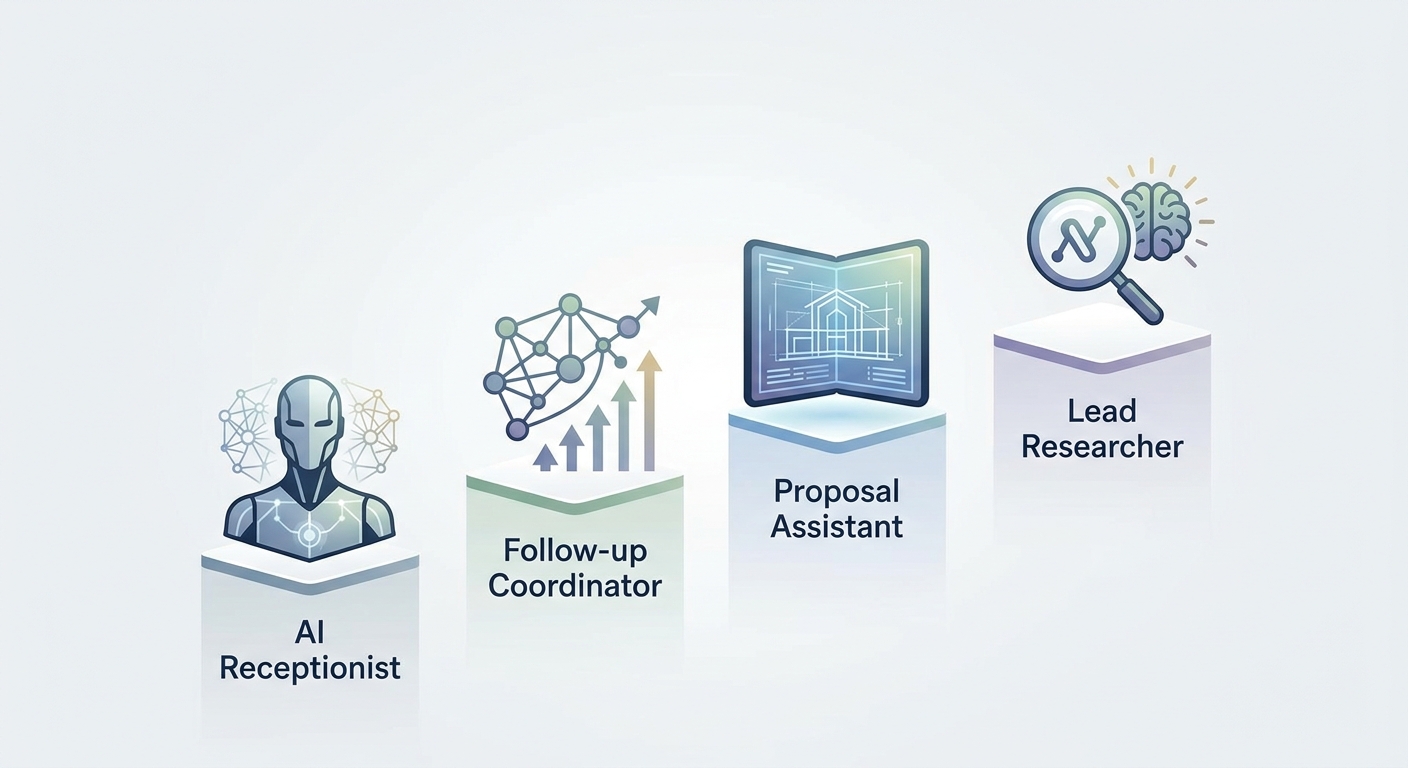
    The Four Pillars of Your Digital Staff

    Most businesses need the same four roles covered. Let’s break them down.

    1. AI receptionist: your 24/7 front desk

    What it does:
    Answers calls. Books appointments. Routes urgent matters to the right person.

    Why it matters:
    You can’t answer every call. Neither can your team. But every missed call is a missed opportunity.

    AI receptionists fill the gap. They pick up on the first ring, handle common questions, schedule appointments directly into your calendar, and escalate complex issues to humans.

    Setup takes 5-15 minutes for basic configurations. Most platforms charge around $199/month—less than a day of a human receptionist’s salary.

    Who needs this:
    Professional service firms, medical offices, agencies—anyone who can’t afford to miss inbound calls but can’t justify a full-time front desk.

    Real-world impact:
    A medical practice in our network was having nurses answer phones mid-appointment. They switched to an AI receptionist for scheduling. Result? Nurses focus on patient care. Patients get immediate scheduling. No more “I’ll call you back.”

    2. Follow-up coordinator: the persistence engine

    What it does:
    Sends follow-up emails. Nurtures leads based on behavior. Tracks engagement. Adapts messaging based on what’s working.

    Why it matters:
    Most leads don’t convert on first contact. They need 5, 7, sometimes 10 touches. You know this. But actually doing it? That’s where businesses fail.

    AI follow-up coordinators don’t forget. They track who opened what, who clicked where, and adjust their approach accordingly. Not static drip campaigns—adaptive, behavior-driven conversations.

    64% of businesses using AI for lead generation report higher-quality leads than manual outreach. The reason? Consistency. AI doesn’t get busy. It doesn’t lose track. Every lead gets the attention it deserves.

    Who needs this:
    B2B companies with long sales cycles. Service businesses where leads take time to convert. Anyone frustrated by prospects going cold.

    Real-world impact:
    A B2B SaaS company added a follow-up coordinator to their pipeline. 30% increase in qualified meetings. Sales team stopped chasing lukewarm leads and focused on closing ready buyers.

    3. Proposal assistant: win more, write less

    What it does:
    Analyzes RFPs. Drafts responses from your content library. Checks compliance. Flags missing requirements.

    Why it matters:
    Proposals take forever. You’re pulling from old docs, rewriting sections, making sure you didn’t miss a compliance checkbox. Meanwhile, your competition already submitted.

    AI proposal assistants can automate up to 80% of the process. They pull relevant content, adapt it to the RFP requirements, and hand you a near-complete draft for final review.

    Microsoft reported a 50% reduction in content library maintenance after implementing AI-powered proposal tools. Faster turnaround. Higher win rates. Less busywork.

    Who needs this:
    Agencies, consultancies, B2B service providers—anyone responding to RFPs or writing custom proposals regularly.

    Real-world impact:
    A marketing agency was spending 10-15 hours per RFP response. After implementing a proposal assistant, they cut that to 3-4 hours of review and customization. Same quality. Triple the capacity.

    4. Lead researcher: intelligence on autopilot

    What it does:
    Researches prospects. Enriches CRM data. Scores leads in real time. Flags buying signals.

    Why it matters:
    Your sales team spends hours researching prospects before making calls. Company size, recent news, decision-makers, budget signals—it’s necessary, but it’s slow.

    AI lead researchers handle the grunt work. They pull data, score fit, identify intent signals, and surface the leads most likely to convert. Your team shows up to every call prepared.

    The best part? It updates continuously. A prospect visits your pricing page? Score goes up. They engage with a competitor? You know instantly.

    Who needs this:
    Sales teams, business development, account-based marketing—anyone doing outbound or managing a large pipeline.

    Real-world impact:
    One team cut research time from 30 minutes per lead to under 5. Same quality intel. More calls. Better close rates.

    How to build your digital staff (without breaking anything)

    Don’t try to do this all at once. Here’s the smart approach.

    Step 1: Identify your biggest bottleneck

    Ask yourself:

    • Where do leads die?
    • What eats the most time?
    • What would benefit from 24/7 coverage?

    For most businesses, it’s either reception (missed calls) or follow-up (leads going cold).

    Step 2: Start with one agent

    Pick the highest-impact role. Implement it. Get it working. Then add the next.

    Trying to deploy four agents at once is how projects stall. One at a time. Nail it, then scale it.

    Step 3: Integration is everything

    Your AI agents need to talk to your systems. CRM, calendar, email—data has to flow.

    Most platforms integrate with HubSpot, Salesforce, Google Workspace, and other common tools. Make sure that’s in place before you launch.

    A receptionist that can’t update your CRM is just an expensive answering machine.

    Step 4: Train and refine

    AI gets better over time. Monitor what’s working. Adjust scoring models. Update response templates. Tweak qualification criteria.

    Think of it like onboarding a new hire. They improve with feedback.

    What this means for your business

    Human-AI Partnership

    The math

    Traditional receptionist: $35,000–$50,000/year + benefits
    AI receptionist: ~$2,400/year

    Follow-up coordinator (fractional hire): $30,000–$40,000/year
    AI follow-up: ~$1,200–$3,000/year (depending on volume)

    For most SMBs, payback happens in 2-4 months. After that, it’s pure margin improvement.

    The reality check

    AI doesn’t replace humans. It amplifies them.

    The best results come from pairing AI with people. AI handles the repetitive stuff. Humans handle the complex, relationship-driven work.

    So the question isn’t “Should I replace my team?” It’s “What should my team focus on?”

    If your sales team spends half their day researching leads, you’re wasting talent. Let AI research. Let humans sell.

    The competitive edge

    Early adopters are scaling faster. They’re responding to leads within minutes, not hours. They’re winning proposals because they’re first to respond. They’re closing deals because nothing falls through the cracks.

    You don’t have to be an early adopter. But you do need to keep pace.

    Getting started

    Here’s your action plan:

    1. Assess where you need help most
    Reception? Follow-up? Proposals? Research? Pick one.

    2. Set a 30–90 day timeline
    Most implementations take a month or two, including setup and refinement.

    3. Avoid these mistakes:

    • Trying to automate everything at once
    • Skipping integration (your agents need to talk to your systems)
    • Setting it and forgetting it (AI improves with monitoring)

    4. Track success metrics:

    • Response time (calls, leads, proposals)
    • Conversion rates (leads to meetings, proposals to wins)
    • Time saved (hours per week your team gets back)

    Your team just got bigger

    Building a digital staff isn’t about cutting costs. It’s about expanding capacity.

    You get a receptionist who never sleeps. A follow-up coordinator who never forgets. A proposal writer who never misses a deadline. A researcher who works in the background while you focus on closing.

    The shift is from “doing everything” to “orchestrating everything.” You become the conductor. Your digital staff handles the notes.


    Ready to build yours?

    Eclipse Digital helps businesses implement AI agents without the guesswork. We’ll assess your bottlenecks, recommend the right tools, handle integration, and train your team.

    If you’re tired of missed opportunities and maxed-out capacity, let’s talk.

    Contact Eclipse Digital to schedule a Digital Staff Assessment.


    Published by Eclipse Digital • March 2026

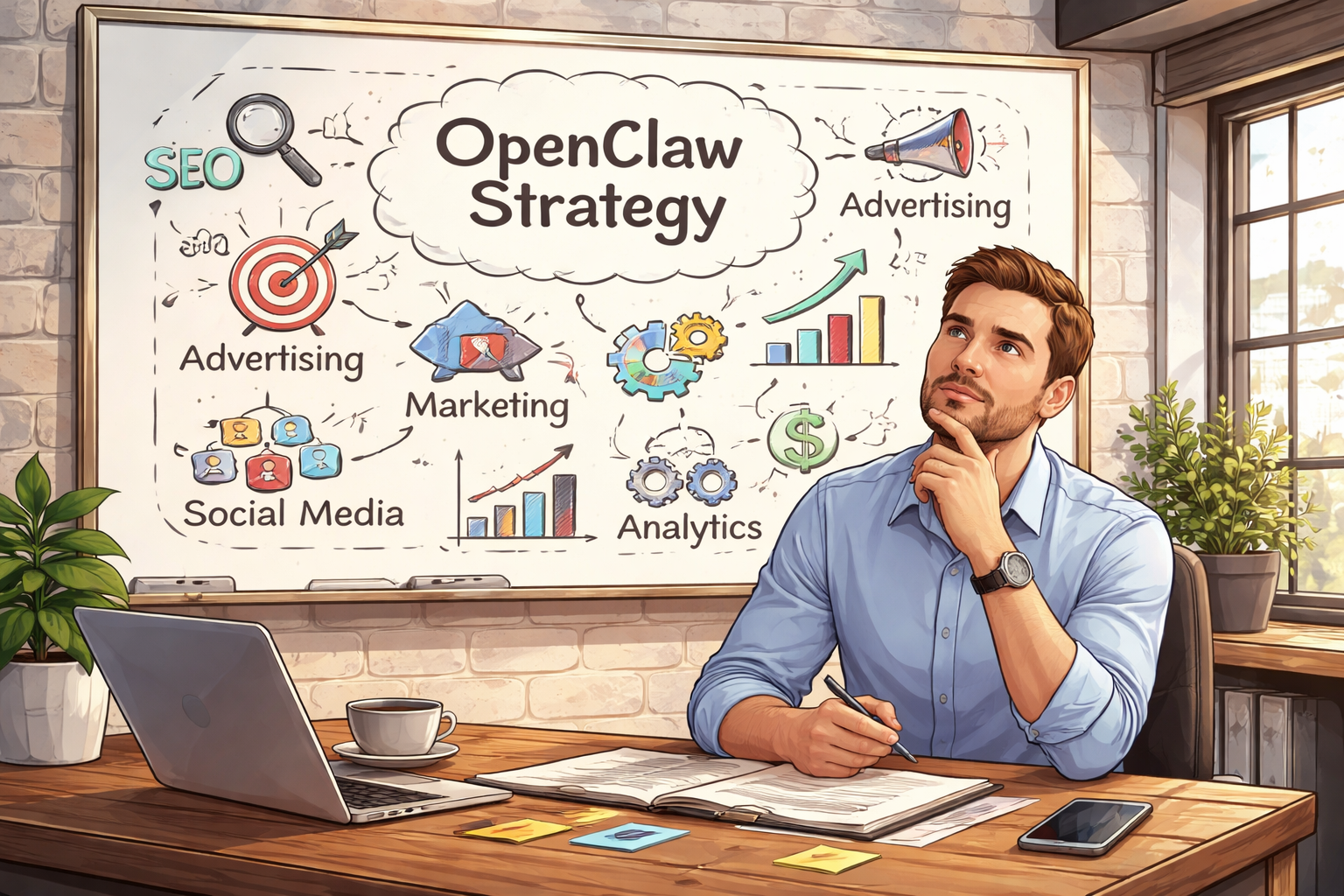
  • What’s Your OpenClaw Strategy? Moving from Random AI Tools to Real Business Automation

    What’s Your OpenClaw Strategy? Moving from Random AI Tools to Real Business Automation

    You’re using AI. Your team is using AI. Everyone’s using AI.

    But here’s the uncomfortable question: Do you have an AI strategy?

    If you’re like most businesses right now, the honest answer is no. You’ve got ChatGPT subscriptions scattered across departments. A few Zapier workflows cobbled together by that tech-savvy marketing manager. Maybe your CRM added an AI feature you’re sort of using. Perhaps someone in operations discovered Claude and swears by it for writing reports.

    This is what Thryv and the U.S. Chamber of Commerce are calling “Shadow AI” or “AI Sprawl” in their recent surveys. It’s the business equivalent of having a dozen disconnected apps all trying to solve the same problem in different ways. And while it feels like progress, it’s actually creating a dangerous illusion of improvement.

    The truth is, there’s a massive difference between using AI tools and having an AI strategy. One is reactive, fragmented, and expensive. The other is systematic, integrated, and genuinely competitive.

    The question isn’t whether you should adopt AI. You’re already doing that. The real question is: when will you stop accumulating tools and start building infrastructure?

    The hidden cost of “winging it”

    Recent surveys from Thryv and the U.S. Chamber of Commerce reveal that 55-68% of small and mid-sized businesses are now using AI in some capacity. That’s remarkable growth in just two years. But dig deeper into those numbers, and you’ll find something troubling: most of these businesses are just experimenting, not executing.

    They’re paying for multiple subscriptions. ChatGPT Plus, Jasper, Copy.ai, Zapier, maybe a few API credits here and there. Each tool promises to save time. Each integration claims to boost productivity. Yet somehow, teams feel busier than ever, drowning in a sea of disconnected platforms that don’t talk to each other.

    Here’s what that “winging it” approach actually creates:

    Data silos everywhere. Your marketing AI doesn’t know what your sales CRM knows. Your customer support tool can’t access your product database. Every system operates in isolation, forcing humans to be the connective tissue, copying, pasting, translating, and manually syncing information between platforms.

    Security blind spots. When employees adopt tools independently, IT has no visibility into what data is flowing where. Sensitive customer information gets pasted into third-party platforms with unknown data policies. Compliance becomes a nightmare. You can’t protect what you can’t see.

    Subscription bloat. Five team members each paying for their own ChatGPT Plus account. Three different automation platforms because different departments started with different tools. Duplicate functionality across systems because nobody realized another team already solved that problem.

    Cognitive overhead. Your team spends mental energy not just on their actual work, but on remembering which tool to use for what, how to format data for each platform, and which workarounds make incompatible systems cooperate.

    This isn’t progress. It’s chaos with a modern interface.

    The problem isn’t the individual tools (many are excellent at what they do). The problem is treating AI adoption as a procurement decision rather than an architectural one. You wouldn’t build a house by buying random building materials and hoping they fit together. Why would you build your business’s AI infrastructure that way?

    Tactical vs. strategic: a real-world comparison

    Let’s make this concrete. Consider two approaches to the same business problem: handling customer email inquiries.

    The tactical approach:
    Your customer service rep gets an email. They copy the message into ChatGPT and ask it to draft a professional response. They review the output, make some edits, then paste it into their email client and send it. Maybe they log the interaction in a spreadsheet. If they’re sophisticated, they’ve got a Zapier workflow that moves certain emails to a specific folder.

    This saves a few minutes per email. It feels productive. It is, marginally, better than nothing.

    The strategic approach:
    An OpenClaw agent monitors the inbox continuously. When an email arrives, it automatically categorizes the intent (support request, sales inquiry, partnership proposal). It pulls relevant context from your CRM: previous interactions, account status, outstanding issues. It cross-references your knowledge base for product-specific details. It drafts a contextually appropriate response that maintains your brand voice and includes accurate information. For routine inquiries, it sends the response autonomously. For complex situations, it flags the message for human review with a summary of the situation and a recommended approach.

    No copying. No pasting. No context switching. No manual logging. The entire workflow is invisible until human judgment is actually needed.

    See the difference? One is a productivity hack. The other is infrastructure.

    The tactical approach makes individual tasks slightly easier. The strategic approach eliminates entire categories of work while simultaneously improving quality, consistency, and response time.

    This distinction (tactical versus strategic) is the divide in AI adoption right now. Most businesses are stuck in the tactical mindset, asking “What can AI do for me?” when they should be asking “How should AI reshape how we work?”

    What OpenClaw actually is (and isn’t)

    Let’s clear up a common misconception: OpenClaw isn’t another chatbot. It’s not a tool you open when you need to write something or analyze data. It’s not competing with ChatGPT or Claude or Gemini.

    OpenClaw is an orchestration layer. A central nervous system for business automation that connects and coordinates everything else.

    Think of it this way: Individual AI tools are like having talented specialists who work in separate offices and never communicate. OpenClaw is the organizational structure that lets those specialists collaborate, share context, and work toward common goals.

    At its core, OpenClaw provides three critical capabilities that scattered tools simply cannot:

    Workflow automation that actually works. True automation means eliminating human intervention from routine processes, not just making those processes slightly faster. OpenClaw can monitor triggers across multiple systems, make contextual decisions about what to do next, execute complex multi-step workflows, and handle exceptions intelligently, all without someone clicking “Run” each time.

    Data integration across your entire business. OpenClaw breaks down the silos. It connects your CRM with your email with your calendar with your project management system with your analytics platform. When an AI agent needs information, it has access to your complete organizational context, not just whatever data lives in one isolated tool. This isn’t just convenient. It’s the difference between AI that can actually make informed decisions versus AI that generates plausible-sounding nonsense.

    Custom agents working together. This is where it gets interesting. Rather than having one general-purpose AI trying to do everything adequately, OpenClaw lets you deploy specialized sub-agents, each with specific expertise, access rights, and responsibilities. A content creation agent that understands your brand voice. A code review agent that knows your tech stack. A customer support agent with full access to your support history and product documentation.

    These agents don’t just exist in parallel. They coordinate. The support agent can hand off to the sales agent when it detects an upsell opportunity. The content agent can collaborate with the research agent to produce articles grounded in your actual data. The workflow is orchestrated, not improvised.

    This is what infrastructure looks like. Not a collection of point solutions, but an integrated system designed to evolve with your business.

    What a real OpenClaw strategy includes

    Building an actual AI strategy (not just accumulating tools) requires thinking through several layers that most businesses haven’t considered.

    Process auditing before implementation. You can’t automate chaos. Before deploying OpenClaw, you need a clear picture of your actual workflows, not how you think they work or how they’re documented, but how work actually flows through your organization. Where are the handoffs? Where does information get stuck? Which repetitive tasks consume disproportionate time? What decisions require human judgment versus rules-based processing?

    This isn’t a technology question. It’s a business architecture question. The most successful OpenClaw deployments start with brutal honesty about which processes deserve automation and which need redesign first.

    Integration architecture. Once you understand your workflows, you need to map the integration needs. What systems need to talk to each other? What data needs to flow where? What access permissions and security boundaries matter? How do you handle exceptions and edge cases?

    This is where many DIY automation projects fail. They solve the happy path but fall apart when reality introduces complexity. A proper OpenClaw strategy includes solid error handling, graceful degradation, and human escalation paths for situations that genuinely require judgment.

    Custom agent development. Generic AI is useful for generic tasks. But your business isn’t generic. Your competitive advantage comes from doing specific things in specific ways that reflect your unique expertise and relationships.

    Custom OpenClaw agents embody that uniqueness. They’re trained on your data, configured to your processes, and designed to amplify your specific capabilities. A content agent for a law firm operates very differently than one for a marketing agency, not because the underlying AI is different, but because the strategy and context are different.

    Ongoing optimization and governance. Here’s what nobody tells you about AI systems: they’re not set-it-and-forget-it. As your business evolves, your automation needs to evolve too. New products launch. Processes change. Regulations update. Customer expectations shift.

    A real OpenClaw strategy includes governance: who can deploy new agents, what data they can access, how performance is measured, when human oversight is required. It includes monitoring, not just “is it running,” but “is it producing the outcomes we actually care about?” And it includes iteration, continuously refining and expanding capabilities based on what you learn.

    Why this requires a partner (not just software)

    If OpenClaw is so powerful, why can’t you just download it and start automating?

    Technically, you could. OpenClaw is open-source. But here’s the reality: implementing strategic automation is different from installing software.

    The technology is the easy part. The hard part is the translation layer between what OpenClaw can do and what your business needs it to do. That’s not a technical problem. It’s a strategy problem.

    Think about what’s actually required:

    – Understanding your business deeply enough to identify automation opportunities you might not see yourself
    – Auditing existing workflows to find inefficiencies, redundancies, and bottlenecks
    – Designing an integration architecture that balances power with security and maintainability
    – Building and configuring custom agents that genuinely understand your specific context
    – Training your team not just to use the system, but to think differently about how work gets done
    – Providing ongoing support as your needs evolve and edge cases emerge

    This is where Eclipse Digital operates. We’re not selling software (OpenClaw is free). We’re selling the strategic thinking and technical implementation that turns powerful technology into actual business outcomes.

    We’ve done this before. We understand the patterns. We know which approaches work and which sound good in theory but fail in practice. We can help you avoid the expensive mistakes that come from treating automation as a technology project rather than a business change.

    More importantly, we become the ongoing partner who helps you evolve your OpenClaw strategy as your business grows. We don’t install a system and disappear. We build capabilities, transfer knowledge, and position you to continuously expand your automation maturity.

    The ROI of this approach is dramatic. Businesses that move from fragmented AI adoption to unified OpenClaw orchestration consistently report:

    – Time savings measured in hours per employee per week, not minutes
    – Error reduction in data-heavy processes, often 90%+ fewer mistakes
    – Subscription consolidation, replacing 5-10 separate tools with integrated capabilities
    – Competitive advantage from being able to operate at speed and scale that manual processes can’t match

    But perhaps most valuable is the strategic clarity that comes from actually knowing how your AI systems work, what they’re doing, and how they contribute to business goals. No more shadow IT. No more wondering which subscriptions are actually being used. No more data scattered across incompatible platforms.

    Just infrastructure that works.

    The question you need to answer

    Here’s where we are: AI adoption is accelerating whether you’re ready or not. Your competitors are experimenting. Your employees are finding tools. Your customers are experiencing AI-powered service from other companies and developing new expectations.

    The window for deliberate strategy is closing. The longer you operate with fragmented tools and shadow AI, the more technical debt you accumulate. The harder it becomes to untangle the mess and build something coherent.

    So the question isn’t whether you should have an AI strategy. It’s whether you’ll develop one intentionally, with proper architecture, integration, and governance, or whether you’ll let it emerge accidentally from the chaos of everyone doing their own thing.

    One path leads to competitive advantage. The other leads to expensive complexity that makes you less agile, not more.

    You don’t need more AI tools. You probably have enough already. What you need is a strategy that turns those tools (and the new capabilities OpenClaw provides) into genuine business infrastructure.

    You need to move from tactical hacks to strategic architecture.

    You need to move from Shadow AI to deliberate orchestration.

    You need to stop buying tools and start building systems.

    Ready to build your OpenClaw strategy?

    Eclipse Digital specializes in helping businesses make exactly this transition, from AI tool chaos to strategic automation infrastructure.

    We start with an OpenClaw strategy session: a deep-dive audit of your current state, your business priorities, and your automation opportunities. We help you see the patterns you’re too close to notice and design an implementation roadmap that delivers value quickly while building toward long-term change.

    This isn’t about technology for technology’s sake. It’s about giving you the infrastructure to compete, scale, and win in an AI-native business environment.

    Stop accumulating tools. Start building strategy.

    Contact Eclipse Digital to schedule your OpenClaw strategy session and discover what coordinated automation can do for your business.

    —

    The future belongs to businesses that treat AI as infrastructure, not as a collection of apps. Which side of that divide will you be on?

  • How to create an AI marketing workflow (reality check)

    How to create an AI marketing workflow (reality check)

    You’ve seen the demos. AI that writes perfect emails. Tools that score leads with “99% accuracy.” Platforms that promise to automate your entire marketing operation while you sip coffee and watch the revenue roll in.

    Here’s what they don’t show you: the three weeks spent cleaning up your CRM data. The integration specialist on call at 9 PM trying to connect your legacy email platform to the new AI tool. The brand manager reviewing AI-generated content that sounds like it was written by an enthusiastic robot who’s never actually met your customers.

    AI marketing workflows are powerful. They’re also not point-and-click.

    If you’re a marketing leader evaluating AI adoption or a B2B company knee-deep in implementation, this is the realistic guide you’ve been looking for. No hype. Just the truth about what works, what doesn’t, and where you actually need help.

    What an AI marketing workflow actually looks like

    Start with what you’re building toward. A functional AI marketing workflow isn’t a single tool—it’s an integrated system where AI handles scale and speed while humans provide strategy and creativity.

    Content generation

    AI can produce blog drafts, social media posts, and email copy at scale. But “produce” doesn’t mean “publish.” You’re creating a workflow where AI generates first drafts based on your brand voice guidelines, and humans refine, fact-check, and add the personality that makes content actually connect. Tools like Jasper or ChatGPT can create 80% of a blog post in minutes. Getting that last 20% right—the stuff that sounds like your brand—requires human judgment.

    Lead scoring and qualification

    This is where AI shines. By analyzing behavioral data (website visits, email opens, content downloads) and firmographic information (company size, industry, role), AI can score leads in real-time. Your sales team stops chasing cold leads and focuses on prospects showing genuine buying signals. But someone needs to define what “high-intent behavior” actually means for your business and continuously refine those models.

    Email personalization

    Gone are the days of “Dear [First Name]” being considered personalized. AI-powered email workflows use dynamic content blocks that adapt based on recipient behavior, industry, previous interactions, and stage in the buyer journey. The same campaign can send hundreds of variations. But designing those variations, deciding which triggers matter, and A/B testing the strategy? That’s human work.

    Analytics and optimization

    AI processes campaign data faster than any human analyst could. It identifies patterns, predicts performance, and recommends channel optimizations. The catch: it tells you what’s happening and predicts what might happen. Deciding what to do about it—that’s still your call.

    Customer interaction

    AI chatbots handle the initial engagement, answer FAQs, and qualify visitors before routing complex questions to human agents. This works beautifully for “What are your business hours?” It needs careful handoff protocols for “We’re considering a $500K contract and have questions about enterprise support.”

    This is the vision. Now we need to talk about why getting there isn’t as simple as signing up for a platform.

    The implementation reality: pain points nobody warns you about

    If you’ve tried implementing AI marketing tools, you’ve hit at least one of these walls. If you’re just starting, buckle up.

    Data quality and privacy: the 40% problem

    More than 40% of companies cite data privacy and quality as their biggest AI adoption hurdle—and for good reason. AI is only as good as the data you feed it. That CRM with duplicate contacts, outdated job titles, and inconsistent formatting? AI will learn from that mess and amplify it.

    Then there’s privacy compliance. GDPR, CCPA, and industry-specific regulations don’t care how innovative your AI workflow is. You need clean data pipelines, clear consent management, and audit trails. Most marketing teams aren’t set up for this level of data governance.

    Real example: A B2B company spent four months preparing their customer data for AI lead scoring. Not because the AI was complicated—because their data was scattered across three systems with conflicting customer records.

    Integration complexity

    You’ve got HubSpot for email, Salesforce for CRM, Google Analytics for web data, and now you want to add AI-powered content creation and lead scoring. Making these systems actually talk to each other—passing data back and forth in real-time without breaking—is genuinely difficult.

    Legacy systems weren’t designed to integrate with AI tools. You’ll need APIs, middleware, custom connectors, and someone who understands how data flows through your entire marketing stack. Tool sprawl is real, and every new platform adds complexity.

    Skill gaps

    Your marketing team knows marketing. They probably don’t know prompt engineering, model fine-tuning, or how to interpret AI confidence scores. This isn’t a criticism—it’s just reality.

    Building an effective AI marketing workflow requires cross-functional expertise: marketers who understand strategy, data specialists who can prepare and manage datasets, technical staff who handle integrations, and increasingly, people who know how to “talk to” AI systems effectively. Most companies don’t have this team assembled.

    Brand voice consistency

    AI can write 500 social posts in an hour. Will they sound like your brand? Probably not at first.

    AI-generated content has a distinctive… blandness. It’s grammatically correct and informationally accurate, but it lacks personality. Training AI to match your brand voice—the tone, the specific phrases you use, the subjects you avoid—takes time and continuous refinement. You need humans reviewing outputs, flagging what’s off-brand, and feeding that back into the system.

    One marketing director put it bluntly: “Our first AI-generated emails sounded like a friendly corporate lawyer. Technically fine, but nobody would ever hit reply.”

    Strategy and optimization

    Many organizations implement AI tools without a clear strategy. They know they’re “supposed to” use AI, so they subscribe to platforms and hope for the best. This doesn’t work.

    You need defined goals (what are you trying to achieve?), success metrics (how will you know it’s working?), and continuous optimization processes. AI isn’t set-and-forget. It requires ongoing monitoring, A/B testing, prompt refinement, and strategic adjustments.

    Where the AI consultant comes in

    This is the part where we’re supposed to say “and that’s why you need us!” But we should be specific about what an AI consultant actually does—and why it’s worth the investment.

    Strategy and planning

    Before you touch a single tool, you need a strategy. Which parts of your marketing operation will benefit most from AI? What are your current bottlenecks? Where are you spending human time on tasks that could be automated, and where do you need more human involvement, not less?

    A good consultant audits your current state, identifies high-impact use cases, and creates a phased implementation plan. This prevents the “we bought five AI tools and use 10% of their features” problem.

    System integration and configuration

    Someone needs to actually connect your systems, configure data flows, and set up the workflows. This is technical work that requires understanding both the marketing goals and the technical architecture.

    Consultants build the pipelines that let your CRM data flow into your lead scoring model, ensure email personalization engines pull from the right data sources, and create feedback loops so your systems learn from results.

    Prompt engineering and fine-tuning

    Getting AI to produce useful outputs is a skill. It’s the difference between “write a blog post about cybersecurity” (which produces generic fluff) and a carefully crafted prompt that specifies audience, tone, key points, length, and brand voice guidelines.

    Consultants develop prompt libraries, train AI models on your existing content, and fine-tune systems to match your brand. This dramatically improves output quality and reduces the human editing time required.

    Ongoing optimization

    AI marketing workflows aren’t static. Performance drifts. Models need retraining. New data sources become available. Consultants monitor performance, identify when systems need adjustment, and implement improvements.

    They also interpret analytics—not just “here’s what the dashboard says,” but “here’s what it means and here’s what we should change.”

    Training your team

    Eventually, your team needs to own these systems. Good consultants don’t create dependency—they transfer knowledge. They train your marketers on prompt engineering, teach your data team how to maintain data quality, and show your analysts how to optimize AI performance.

    The goal is to make your team self-sufficient, not to keep you paying consulting fees forever.

    Building your AI marketing workflow: step-by-step

    Here’s the practical roadmap for companies ready to do this right.

    Step 1: Audit your current state

    Map your existing marketing processes. Where are the bottlenecks? What tasks consume the most time? Where are humans doing work that’s repetitive and rules-based? Where do you need human creativity and judgment?

    Also audit your data. Is it clean? Consistent? Accessible? You’ll need to fix data quality issues before AI can be effective.

    Step 2: Identify highest-impact use cases

    Don’t try to automate everything at once. Pick 2-3 high-impact areas where AI can deliver measurable results relatively quickly.

    Common starting points:

    • Lead scoring (if you have enough historical data)
    • Email personalization (if you have a solid email program)
    • Content creation for social media or blogs (if you produce content at scale)

    Avoid starting with areas that require complex integrations or where you lack baseline data.

    Step 3: Choose integrated tools, not disconnected subscriptions

    Tool sprawl is a real problem. Whenever possible, choose platforms that integrate with your existing stack or complete solutions that handle multiple functions.

    HubSpot with AI features beats HubSpot + three separate AI tools that don’t talk to each other. Salesforce Einstein makes more sense than bolting external AI onto Salesforce.

    Think about your data architecture. The more systems data has to flow through, the more opportunities for things to break.

    Step 4: Configure and train systems

    This is where consultants earn their keep. Configure your chosen tools, set up integrations, and train AI models on your data and brand guidelines.

    Expect this to take weeks or months, not days. You’re building infrastructure.

    Test extensively before going live. Run AI-generated content by brand reviewers. Verify lead scoring accuracy against historical conversions. Make sure email personalization is pulling the right data.

    Step 5: Monitor, measure, optimize

    Launch with clear success metrics. Track them religiously.

    • Content generation: Time saved, quality scores, engagement metrics
    • Lead scoring: Conversion rates, sales feedback, score accuracy
    • Email personalization: Open rates, click rates, conversion improvements
    • Overall: ROI, team efficiency, revenue impact

    Schedule regular optimization reviews. What’s working? What’s not? What needs adjustment?

    AI systems improve with feedback. Create processes for humans to flag bad outputs, identify edge cases, and refine models.

    The human-AI partnership

    Here’s the mental model that actually works: AI is your tireless assistant with a perfect memory and zero creativity. Humans are the strategists, creatives, and relationship builders.

    AI handles:

    • Processing large datasets quickly
    • Generating first drafts at scale
    • Identifying patterns humans would miss
    • Executing repetitive tasks consistently
    • Providing real-time scoring and recommendations

    Humans handle:

    • Setting strategy and goals
    • Making judgment calls on edge cases
    • Adding creativity and brand personality
    • Building customer relationships
    • Interpreting insights and deciding what to do
    • Ensuring quality and brand consistency

    The best AI marketing workflows don’t replace marketers—they free them from busywork so they can focus on strategy and creativity.

    One marketing VP described it perfectly: “AI drafts the email. We make it sound like us. AI scores the lead. We decide if we agree. AI processes the data. We decide what it means. It’s a partnership.”

    It’s not point-and-click, but it’s worth it

    If you came here looking for the “easy button” for AI marketing, you’re probably disappointed. There isn’t one.

    Building an effective AI marketing workflow requires strategy, technical expertise, data preparation, integration work, continuous optimization, and realistic expectations.

    But here’s the thing: when done right, it genuinely changes how teams work. Marketing teams operate faster, target more precisely, personalize at scale, and free humans to do the creative and strategic work that AI can’t replicate.

    The companies seeing real ROI from AI marketing aren’t the ones who bought the shiniest tools and hoped for magic. They’re the ones who approached implementation thoughtfully, invested in proper setup, and committed to ongoing optimization.

    They also—usually—worked with consultants who’d solved these problems before and could help them avoid expensive mistakes.

    At Eclipse Digital, we don’t promise that AI will solve all your marketing problems overnight. We help you build AI marketing workflows that actually work—integrated with your existing systems, trained on your brand voice, optimized for your goals, and designed to make your team more effective.

    Not magic. Just careful, strategic implementation.

    If you’re ready to build an AI marketing workflow that delivers results instead of headaches, get in touch.


    About Eclipse Digital

    We’re AI consultants who help B2B companies implement marketing technology that actually works. No hype, no buzzwords—just practical expertise in building AI workflows that integrate with your existing systems and deliver measurable results. 

    Contact us to discuss your AI marketing implementation